
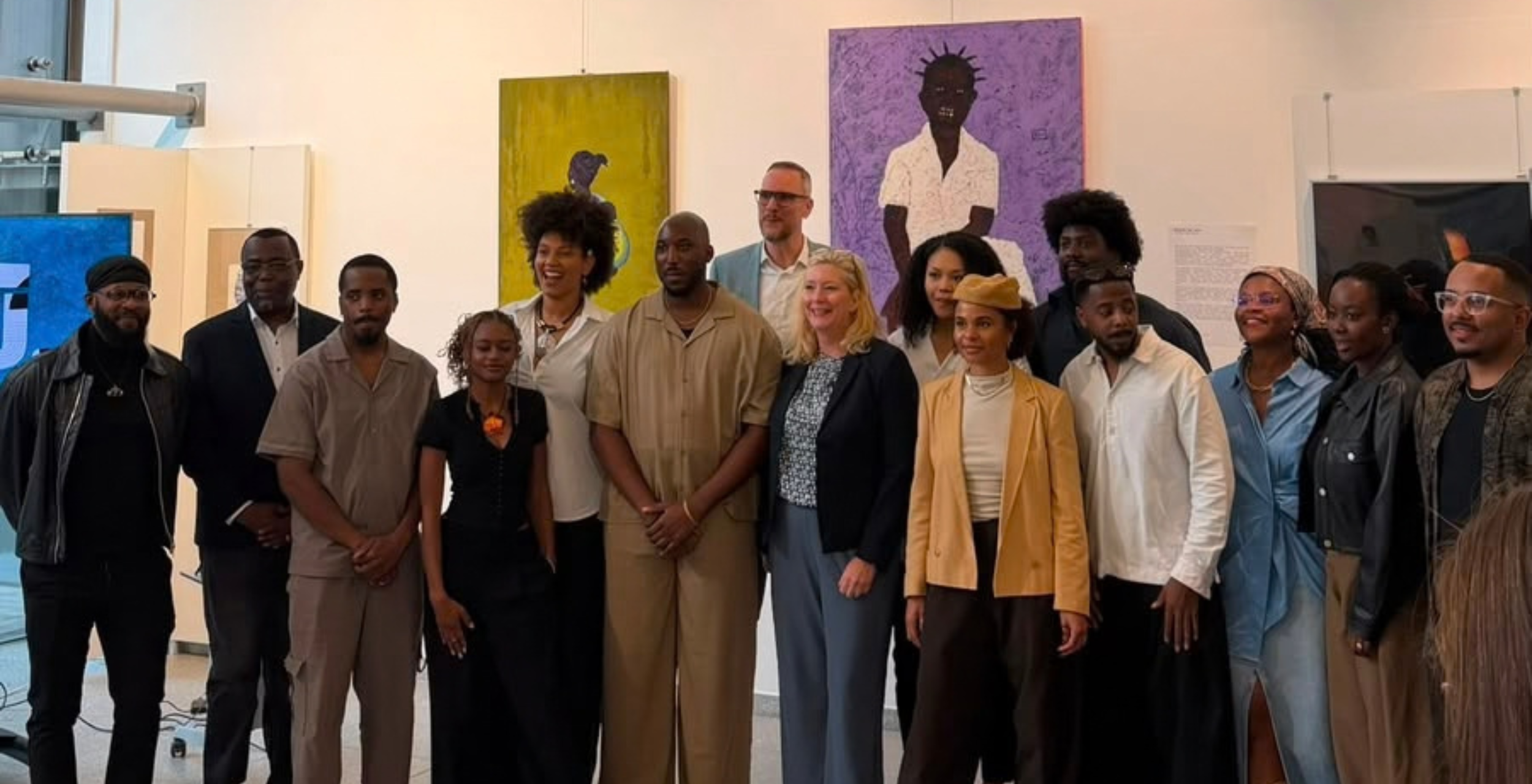
How would you describe Likolo to someone who has never heard of the organisation?
Likolo is a German-Congolese organisation that builds bridges within society through creativity, exchange and education. In particular, we want to support people with a migration background, create spaces for encounters and bring different perspectives together.
What does “Likolo” mean to you personally, and what idea lies behind the name?
“Likolo” comes from my mother tongue, Lingala, which is spoken in the Democratic Republic of the Congo, and roughly means “high” or “up above.” For me, it carries the idea that, as an organisation, we want to aim high and create a lasting impact in the long term. The name represents our ambition to grow beyond ourselves and build something together that creates sustainable change.
How do you, as an organisation, navigate the tension between cultural heritage and contemporary life in Germany?
The fact that many of our members were born in Germany or have built their lives here makes this tension part of our reality. Through the different perspectives and experiences we bring from both cultural contexts, we learn to navigate different social environments without losing our connection to our roots.
For us, it is not about having to choose between two cultures. Rather, it is about carrying elements of our cultural heritage with us while also embracing experiences, values and perspectives that come from living in Germany. Both can exist alongside each other and enrich one another.
How did the idea for the “NTU” exhibition come about?
As a Congolese organisation, we are part of the Central African Bantu language group. When choosing the term “NTU”, we therefore looked to concepts such as “Bantu” and “Muntu”, which refer to the human being or people.
The idea behind the exhibition was to bring different people and perspectives together. Something that also plays an important role in many Bantu cultures. At the same time, we wanted to show just how diverse afrodiasporic creative work in Germany is.
The Ubuntu philosophy is often associated with community, humanity and togetherness. How does this idea become tangible within the exhibition?
On the one hand, the exhibition makes the afrodiasporic community that we represent visible. People with African roots who were born or raised in Germany come together and present their art collectively. At the same time, each person remains individually visible through their own story, perspective and artistic language.
This interplay between community and individuality is a central idea of the exhibition. From the moment you enter the space, we want this connection to be something you can feel.
You are bringing together nine young creatives. What connects the artists, even though their individual artistic perspectives are likely very different?
What connects the artists is that they live and grew up in Germany while also knowing, reflecting on and celebrating their African roots. As an afrodiasporic creative, you often find yourself engaging with similar questions: Where do I belong? How do I define my identity? How do I bring different cultural influences together? The answers are individual for every person, and it is precisely these different perspectives that make the exhibition so exciting.
What do you think is still missing from the cultural landscape of the Ruhr area when it comes to afrodiasporic creatives? And are there already places or initiatives you would like to point visitors and readers towards?
I think there is still a need for more publicly accessible spaces that can be used to create and encourage creative discourse and exchange within an afrodiasporic context.
Afrodiasporic creatives are an important part of German society and bring an incredible amount of potential, perspectives and creativity with them. This potential should be made more visible and supported more strongly.
At the same time, there are already various initiatives, communities and cultural actors, such as Cute Community Radio, that provide people with migrant roots with a platform and help create these kinds of spaces. I think it is important to make these existing structures visible and connect them with one another, rather than constantly starting from scratch.
What would you like visitors to see differently after walking through the exhibition?
I would like visitors not to see afrodiasporic art merely as something aesthetic, but to recognise the stories and emotions behind it.
The works speak about identity, heritage, personal experiences and life between different cultural influences. If visitors leave with these stories and emotions and perhaps also question their own perspective on afrodiasporic life and art, then, for me, the exhibition has achieved something
Editorial Note: You can visit NTU at the Volkshochschule Essen until November 14, 2026. Experience the stories and perspectives of this exhibition for yourself. Also, Thank you to Ruben Matweta for taking the time to speak with me and for sharing the intentions behind the exhibition. To learn more about Likolo and their work, follow the organisation and stay connected to the projects they’re creating here.